The Heritage of Old Goshenhoppen
A Reformed congregation that has worshiped on these grounds for nearly three centuries, through every season God has given. Today, as those before us did, we strive to stay faithful to the Word of God in the storms of our day.
Still a gathered congregation
These grounds are old, but by God’s grace Old Goshenhoppen Reformed Church is still a gathered congregation, meeting every Lord’s Day to hear God speak in His Word.
Every Sunday at 10 AM we seek to preach God’s Word faithfully and without shame, now through the Gospel of Luke, proclaiming Christ as our only comfort. Worship is simple, not a performance: Scripture, prayer, Psalms and hymns, the preached Word and the Lord’s Supper every Lord’s Day, as we strive to worship God with reverence and awe (Hebrews 12:28), resting on His grace alone in Christ. We confess the faith summarized in the Heidelberg Catechism and the historic creeds, the same catechism dearly loved by our founders and still treasured by us today.
We are an elder-led congregation, shepherded by our pastors and elders under the headship of the Lord Jesus. Young and old worship together, pray together and share a fellowship meal after worship every Sunday.
From a barn to Church Road
In November 1725, thirty-seven Reformed settlers at Skippack, a few miles away, received the Lord’s Supper from John Philip Boehm. Boehm’s own letter, written years later, shows that this Skippack congregation is the root of Old Goshenhoppen, which makes it, by God’s kindness, the second-oldest German Reformed congregation in America. They were content there, but they were few.
In September 1727 the ship William and Sarah reached Philadelphia with about four hundred Palatines and Rev. George Michael Weiss, the first ordained German Reformed minister in America and, in time, pastor of Old Goshenhoppen. On October 12 he preached to the Goshenhoppen settlers and gave them the Lord’s Supper. They and the Skippack congregation grew into one people, the Goshenhoppen people, meeting in a farmer’s barn in the Skippack region until they had land of their own.
Why “Goshenhoppen”? In the Bible, Goshen was the land in Egypt where God settled Israel and provided for them before He brought them into the Promised Land (Genesis 45:10; 47:27). The settlers likened this new land to Goshen, a place of God’s provision while they were sojourners. Tradition holds that hoppen means “haven,” and the name also recalls Shakahoppa, a Lenape chief of the area.
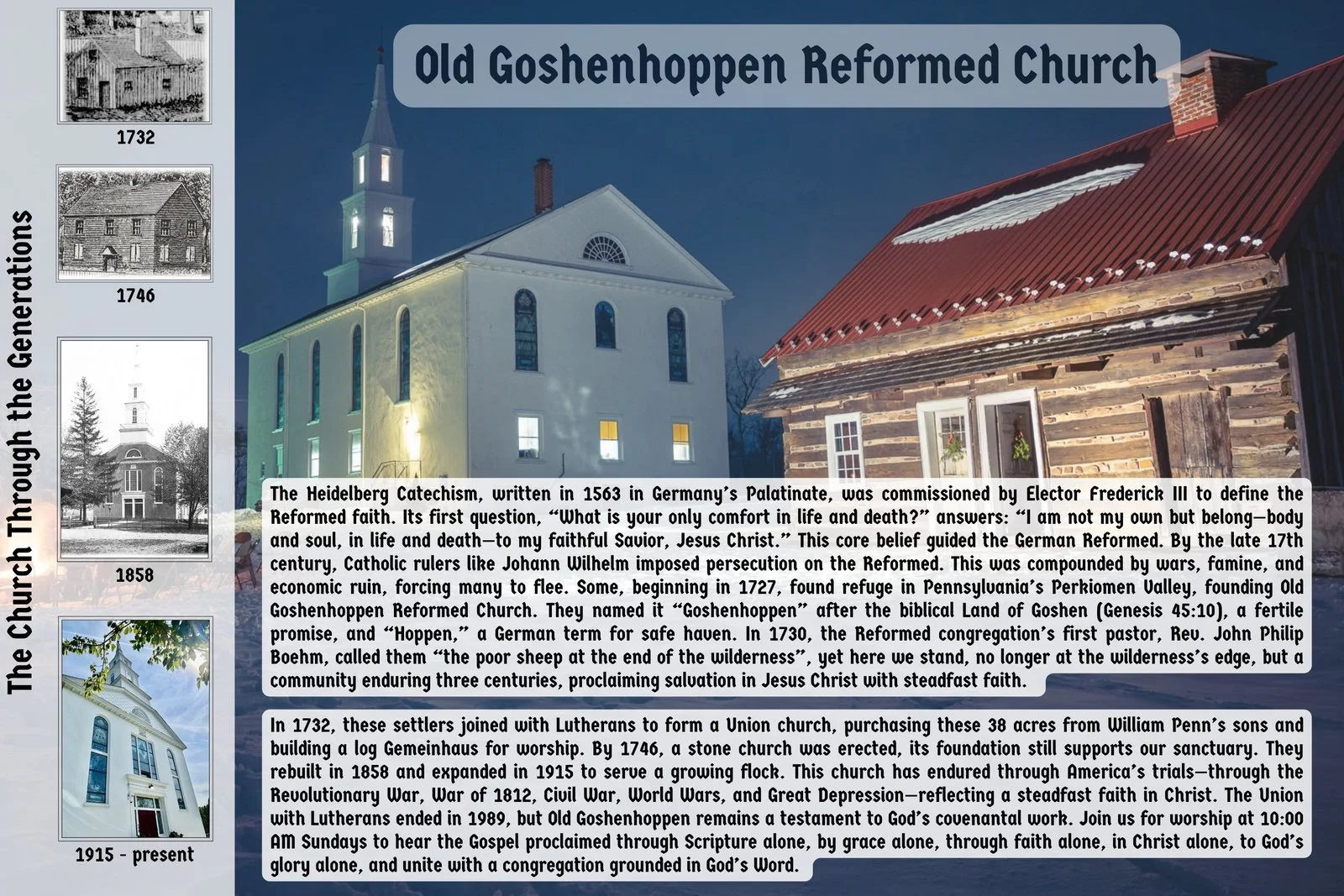
John Boehm wrote to Amsterdam on the congregation’s behalf, and on November 12, 1730, it was recognized there as a New World church plant. In 1732 Lutherans and Reformed began sharing the property as a union church. In 1744 work began on a stone church, dedicated in 1746; we still worship on its foundation. A new, larger church was built on that foundation in 1858, and the most recent remodel, begun under Rev. J. Lucian Roush and finished under Rev. Thomas R. Brendle, was completed in 1915. The Oyster Picnic began in 1877. In 2019 a tornado damaged every structure on the property.
All churches go through seasons, and God has kept a people here through every one of them. We pray He keeps us holding fast to His Word.
Places & ministries of Old Goshenhoppen
The church, the cemetery, the 1732 Gemeinhaus and the ministries that grew up around them, all on the same grounds on Church Road.
Walking tour of the grounds
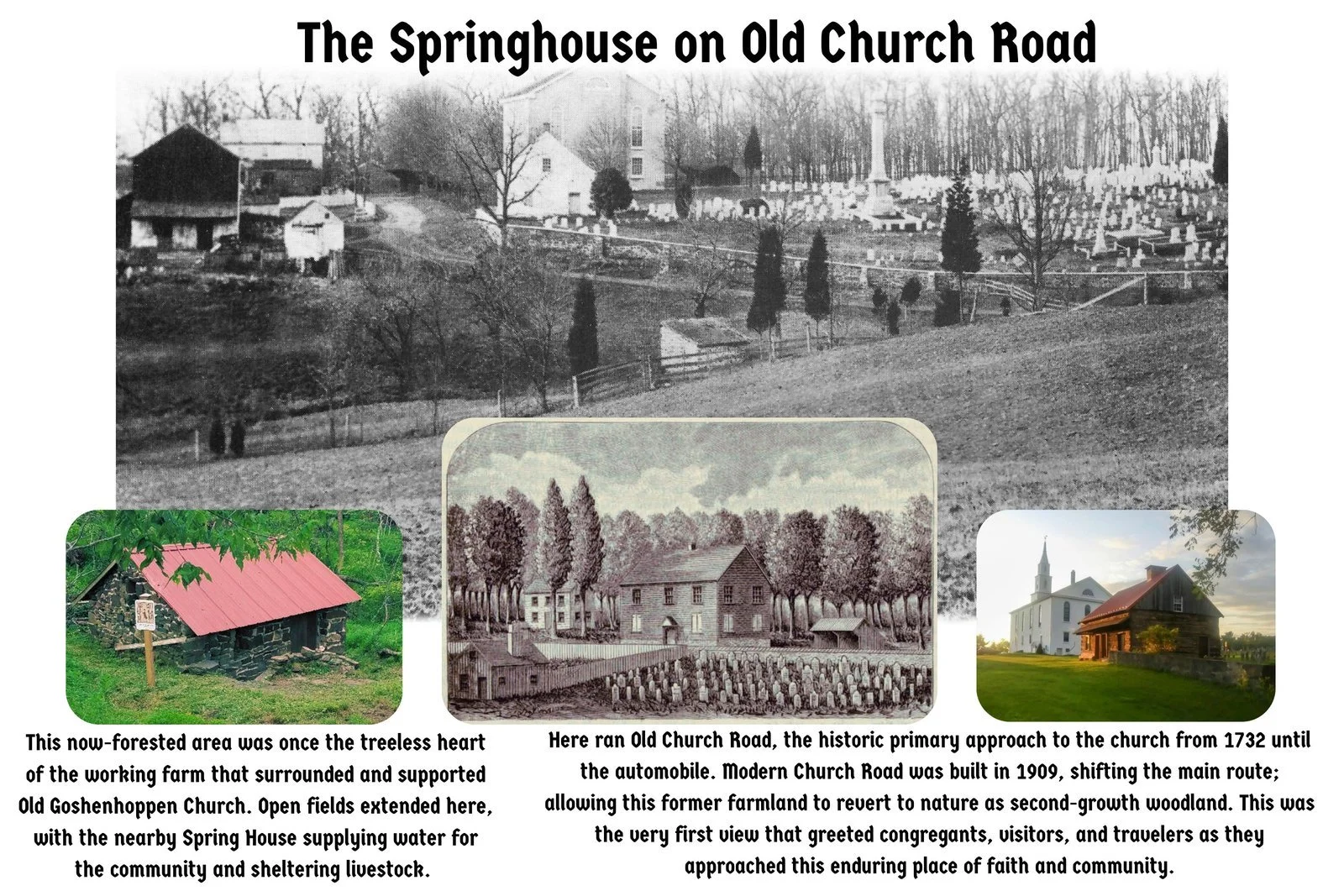
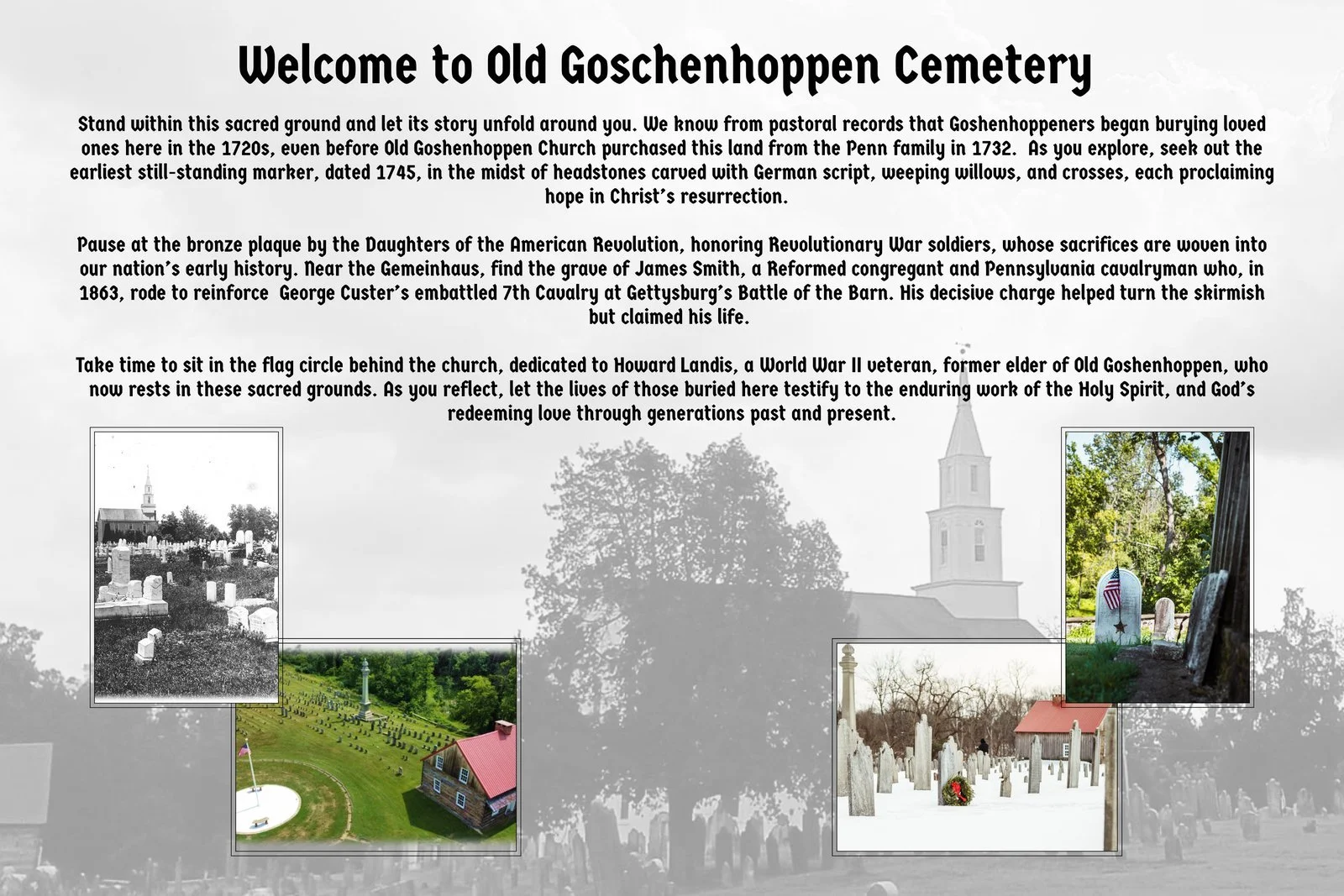
Visitors are welcome to walk the grounds of Old Goshenhoppen at their own pace. Wayside signs along the way tell the story of the people who worshiped, learned and were laid to rest here, and of God’s faithfulness through the generations.
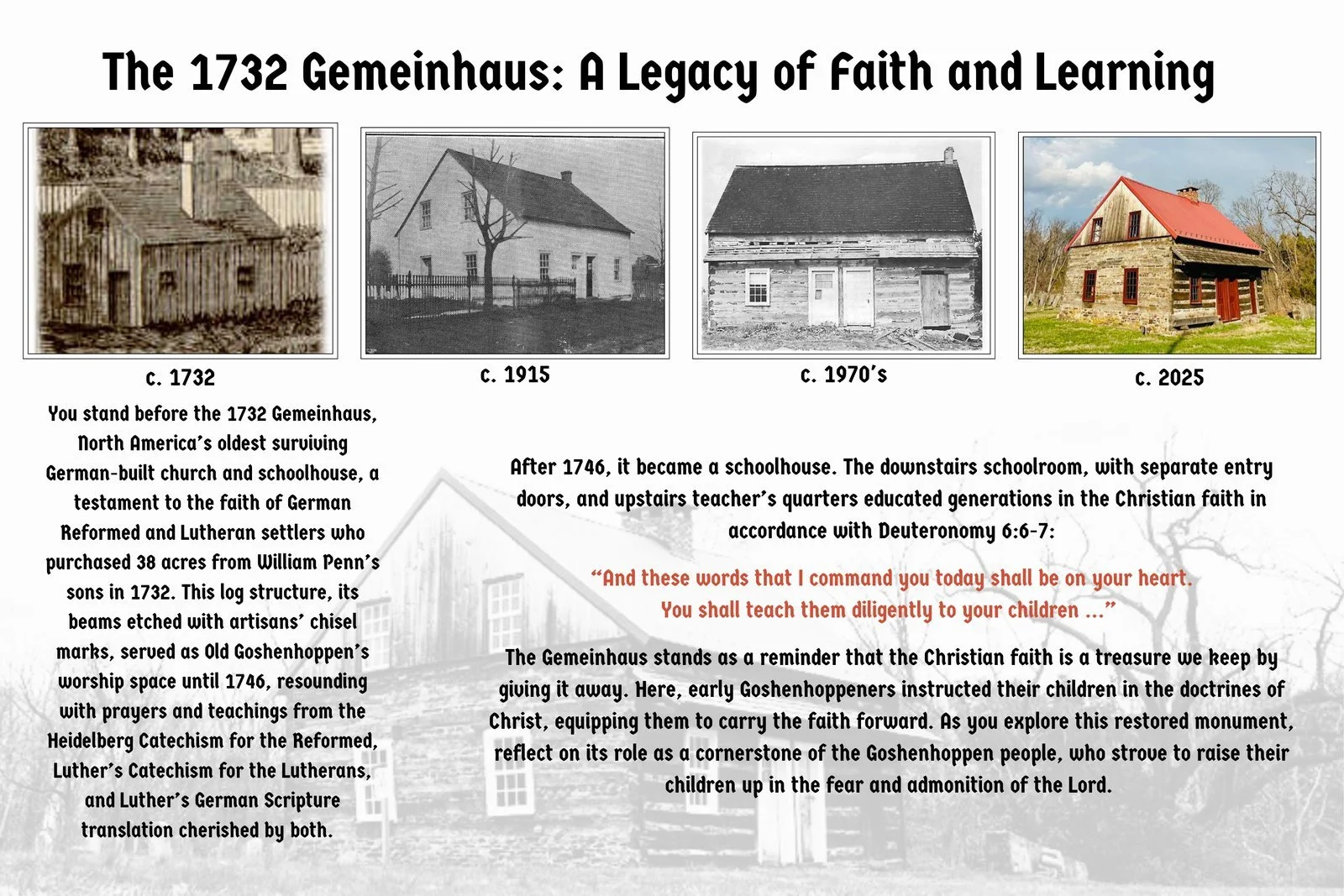
And these words that I command you today shall be on your heart. You shall teach them diligently to your children, and shall talk of them when you sit in your house, and when you walk by the way, and when you lie down, and when you rise.Deuteronomy 6:6–7
The grounds are open to walk. For a guided tour or a group visit, please contact the church.
Help preserve this sacred and singularly unique place
Your gift cares for the grounds of Old Goshenhoppen as a whole, so that its history is handed on to the generations to come.
Upcoming heritage events
Why we say “Since 1727”
Our roots reach back to the Reformed settlers at Skippack, who first gathered at the Lord’s Table under John Philip Boehm. We count our years from the day Rev. George Michael Weiss, newly arrived from the Palatinate, first preached to the Goshenhoppen people and gave them the Lord’s Supper.
Thirty-seven Reformed settlers at Skippack, a few miles away, receive the Lord’s Supper from John Philip Boehm.
On October 12, Rev. George Michael Weiss, newly arrived from the Palatinate, preaches to the Goshenhoppen settlers and gives them the Lord’s Supper. With the Skippack congregation they become one people, the Goshenhoppen people.
John Boehm writes to Amsterdam, and on Nov. 12 the congregation is recognized as a New World church plant.
The union church: Lutherans and Reformed share the property.
Work begins on the stone church in 1744 with its Latin cornerstone, and Rev. Michael Schlatter dedicates it on Sept. 20, 1746. Today’s church still stands on its foundation.
A new, larger stone church is built on the 1744 foundation; the Gemeinhaus still stands behind it.
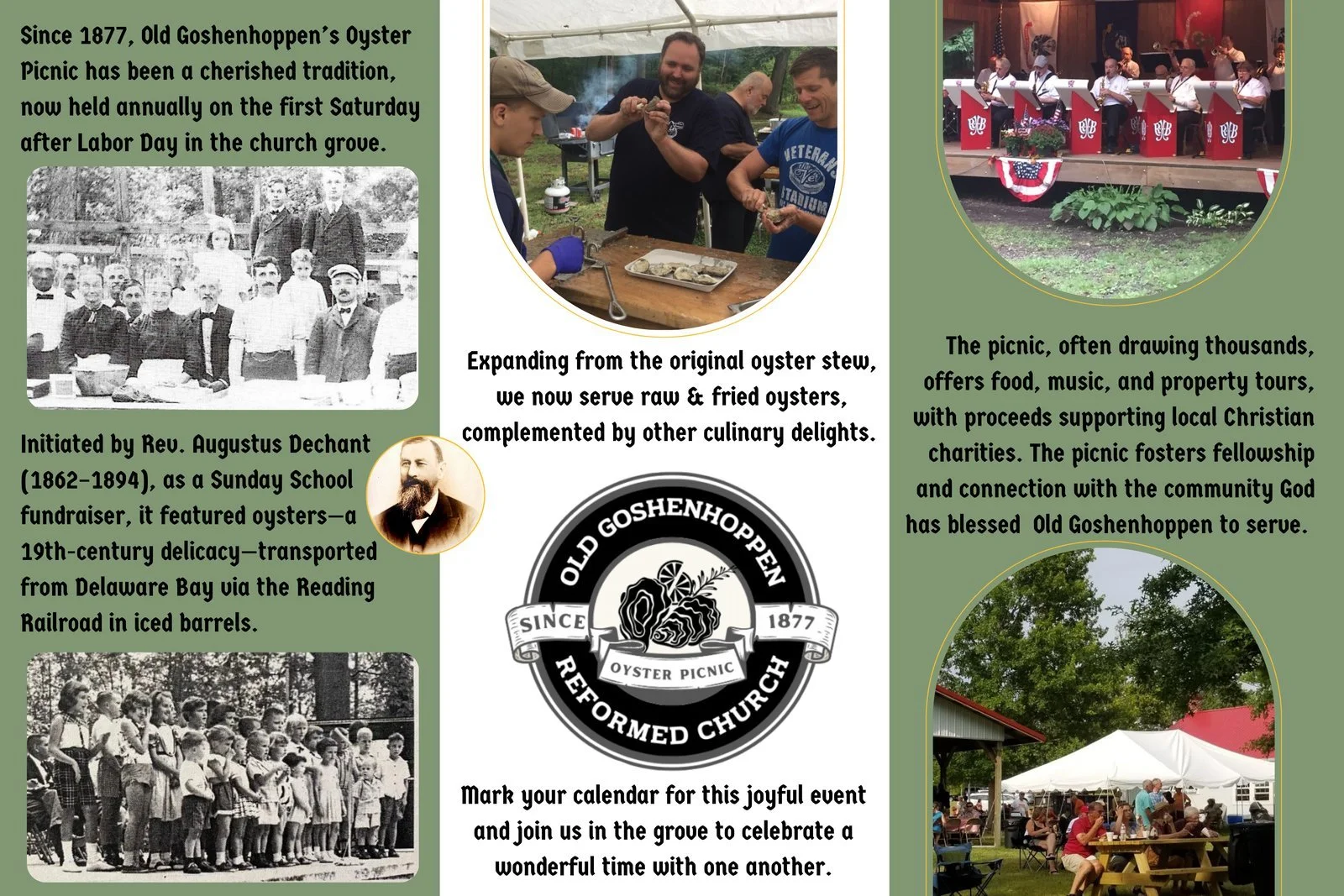
The first Oyster Picnic. The Reading Railroad brought oysters out on ice and visitors from Philadelphia, and it grew into a great end-of-summer gathering. It is still held every year on the first Saturday after Labor Day.
The most recent remodel, begun under Rev. J. Lucian Roush (1890–1913) and finished in 1915 under Rev. Thomas R. Brendle (1913–1926). The sanctuary moved upstairs and stained glass was added. Afterward it was considered one of the most modern churches in the country, down to a listening system for the hearing impaired.
The Lutheran congregation moves; the Reformed congregation continues here.
A tornado damages every structure on the property.
A biblical church striving to stay faithful: prayer at 8:30, Sunday School at 9, and the Word preached and the Supper served every Lord’s Day at 10 AM.
2027. Sat., Sept. 11: the 150th Oyster Picnic. Tue., Oct. 12: 300 years since Rev. George Michael Weiss first preached to the Goshenhoppen people and gave them the Lord’s Supper.